Pool Contractors Bakersfield: How to Choose One Wisely
Learn how to vet Pool Contractors Bakersfield homeowners can trust, read estimates line by line, and plan for code, water loss and upkeep.
The bids are on your kitchen table, and they don't agree on anything. One is a single page with a lump sum and a line that says "everything included." Another runs six pages and prices a heater you never asked about. A third is a text message with a number and a promise to send something formal later. You described the same backyard to all three.
That's the trap. The estimate and the first design drawing are the actual contract. They decide what gets built, what gets left out, what the permit office will demand, and what the pool costs to run every month for the next twenty years. The sticker price on the pretty brochure barely matters by comparison.
Most of a pool's lifetime cost is locked in before an excavator ever crosses your curb. Here's how to read what you're being handed.
Contractor Vetting Checklist Before You Sign Anything
Ask for the documents before you ask for the price. A contractor who has built pools in this valley for a while keeps them ready, and one afternoon on the state's website plus two phone calls tells you more than any showroom visit.
| Check | What good looks like | Red flag |
|---|---|---|
| California license | Active license you can verify on the state contractors board lookup | License number missing or cannot be verified |
| Insurance | Current liability and workers' compensation certificates | Will not provide certificates |
| Local experience | Finished pools you can visit or references you can call | Only renderings and no completed jobs to see |
| Design process | Written plans or 3D renderings before excavation | Verbal promises with no drawing |
| Permits | Contractor pulls permits and names the permit office | Asks you to pull permits or skip them |
| Written estimate | Itemized scope and a payment schedule tied to milestones | Lump sum with no detail |
| Warranty | Written terms for workmanship and equipment | Guarantee exists only as a verbal promise |
| Communication | Named project lead and clear response times | No direct contact after the sale |
Start with the license, because it's a lookup rather than a conversation. The state licensing board shows whether a license is active, what classifications the contractor holds and whether complaints sit on file. Get the number in writing and check it yourself. Insurance means two certificates, general liability and workers' compensation, and you keep copies. On a job that involves excavation, gas lines and standing water, a crew without workers' compensation coverage is a problem that lands on your property record.
Then move to design and permits. A contractor who pulls permits in their own name and can tell you which building department handles your address has done this recently. If the wish list runs toward a vanishing edge, read up on infinity pool construction so the questions you bring are specific instead of general.
The estimate and the warranty carry the most weight. Payments should attach to completed milestones, not to a calendar. Warranty terms should be in writing for both workmanship and equipment, with the duration and the exclusions spelled out. Ask any company what happens when you're unhappy with the result, then see whether the answer is written down. Ours is: if you aren't satisfied with our work for any reason, we'll do everything we can to make it right.
Practical rule: A contractor who resists written terms, wants a large deposit before any design work happens, or offers to skip the permit is showing you a risk you'll pay for later.
Pool Types and What Each Means for Your Budget
Three bids for the same backyard, and one is dramatically cheaper than the other two. Before you read that as a bargain, check what is being priced. Gunite, a fiberglass shell, a vinyl liner and an above-ground kit are four different products with four different cost structures, and a number for one tells you nothing about another.
The volume explains some of the variation. A California Energy Commission filing reported approximately 1.2 million California homes with swimming pools in 2009, equal to about 15% of the state's single-family homes, and the state installs an average of roughly 15,000 new pools a year, according to Los Angelino's 2024 report citing California Public Radio. With that much work around, every builder develops a preferred method and prices toward it.
| Pool type | How it is built | Main strengths | Main trade-offs |
|---|---|---|---|
| Gunite (concrete) | Custom-formed on site over several weeks | Any shape or depth; long service life with resurfacing | Longest schedule; periodic resurfacing |
| Fiberglass shell | Pre-made shell set in place, often within days | Fast install; smooth, low-maintenance surface | Limited shapes and sizes; crane access required |
| Vinyl liner | Wall panels or framed walls fitted with a liner | Lower upfront cost; flexible shapes | Liner replacement every several years |
| Above-ground | Kit assembled on a level pad | Lowest cost and fastest to set up | Shorter lifespan; limited depth and resale value |
Gunite buys you shape freedom and a shell that can be resurfaced instead of replaced, and it costs you weeks of schedule. Fiberglass buys speed, and it caps your dimensions and needs a crane to reach the yard. A liner is the cheapest way into an in-ground pool and the most predictable recurring expense. Above-ground is the entry point, with the shortest horizon.
Compare bids only after you've confirmed they cover the same construction type. A lower price for a cheaper type isn't a comparison, it's a category error. Bring three questions to every contractor: which type do you recommend for this lot and why, what will it cost to keep in service over ten years, and how does the material handle Bakersfield summer water temperatures.
Reading a Bakersfield Pool Estimate Line by Line
The most common reason two estimates for the same pool differ is that one of them includes a line the other left out. A total without a breakdown can't be compared to anything, so ask each bidder for line-item pricing before you sort them.
| Line item | What to confirm | Ask if missing |
|---|---|---|
| Excavation and haul-away | Soil conditions, depth, disposal of spoil | How hard soil or rock is priced |
| Shell or gunite | Material, thickness, finish | What the finish warranty covers |
| Plumbing and filtration | Pump, filter, pipe size, pipe run length | Pipe run length to equipment |
| Electrical | Bonding, GFCI protection, dedicated circuits | Whether a panel upgrade is included |
| Heating | Heater type and sizing | Whether the heater is included or optional |
| Decking and coping | Material and square footage | Tile or coping upgrades priced separately |
| Fencing and safety cover | Fence code compliance and cover type | Whether the cover is included |
| Permits and inspections | Fees, who pays, re-inspection costs | Who pays for re-inspections |
| Landscaping and cleanup | Grading, planting, debris removal | Lawn and landscape restoration |
| Payment schedule | Payments tied to completed milestones | Any deposit larger than the first milestone |
Excavation deserves the closest read. The line should name the depth, where the spoil goes and how rock or hardpan gets priced, because that's the change order that shows up in week one. The shell line should state material, thickness and finish, since "gunite" alone covers a wide range. Electrical is the quiet one: bonding, GFCI protection and dedicated circuits belong in writing, and a panel upgrade either is or isn't in the number.
Heating is where lump sums hide the most. A heater listed as optional is a heater you'll buy later at retail plus installation. Decking needs square footage, not "concrete included." Fencing and a safety cover need a line of their own.
A free consultation should account for your budget, your backyard space and how you'll use the pool, then come back with recommendations built around those answers. When we run one, the recommendations are personalized to those three inputs. If a bid reflects none of them, it's a template.
Milestone payments should always be smaller than the work they cover. A deposit larger than the first milestone deserves a direct question.
A bid far below the others usually means a missing line item, not a discount. Find the gap before you celebrate.
Design Decisions That Affect Permits and Heating
In California, equipment is a code decision before it's a style decision. The California Energy Commission's 2025 Energy Code applies whenever pool or spa heating systems, circulation pumps or related equipment are installed, including qualifying alterations. Primary heating must generally be a heat-pump pool heater, a solar-thermal system or a combination, with gas or electric-resistance equipment limited to supplemental use alongside on-site renewable energy. Dedicated-purpose pumps and replacement motors must meet appliance efficiency requirements and appear in the Commission's certified equipment directory.
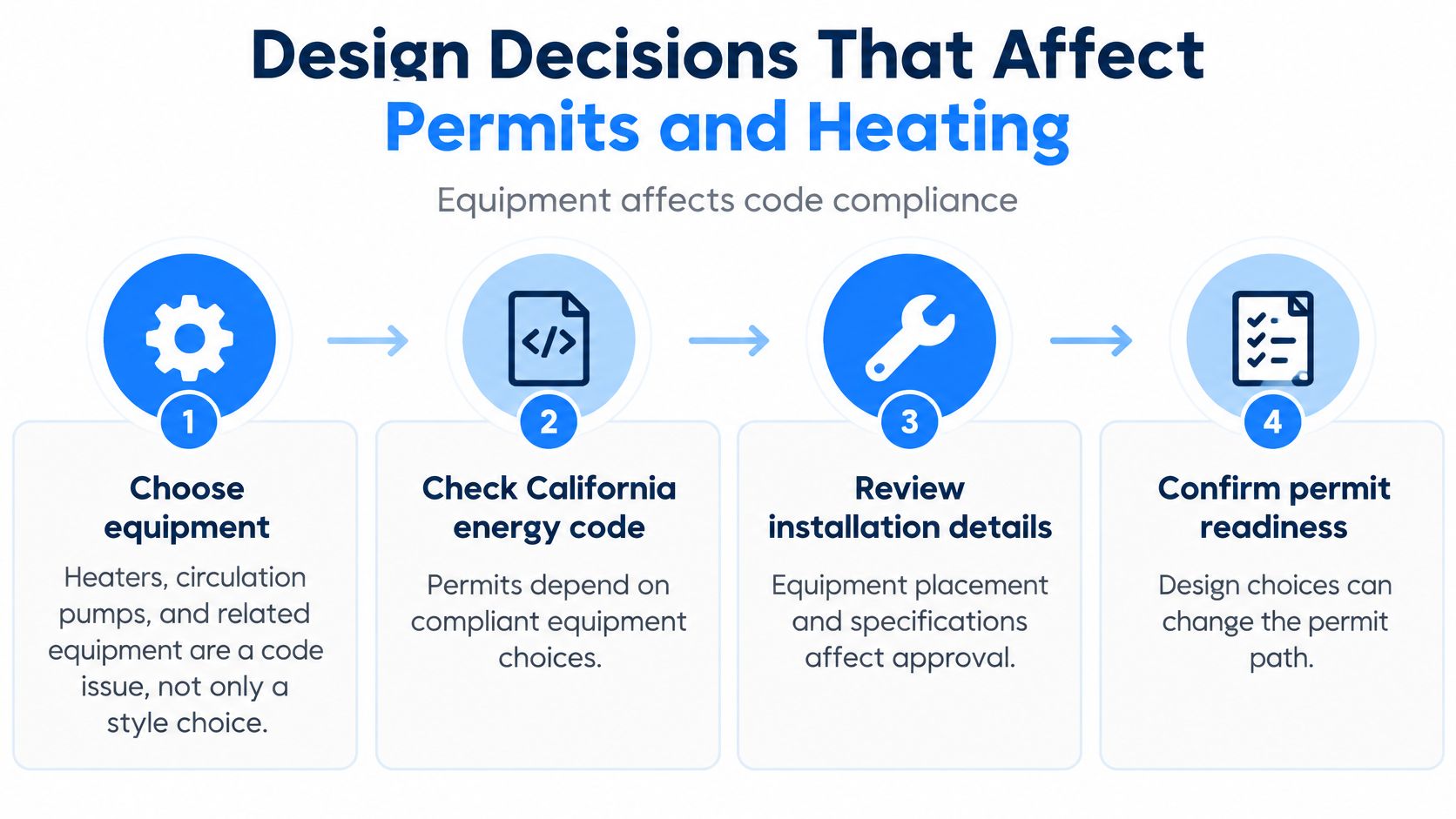
That changes the order of work. The sequence a well-run project follows looks like this:
- Design first. Heater sizing and the intended heating method get settled on paper, not at the equipment pad.
- Draw the pad. The plan shows equipment location, pipe routing, service clearances and valving.
- Check the schedule. Every pump, motor and heater gets matched against the certified directory before it's ordered.
- Review permits. The equipment schedule goes in with the application.
- Only then, excavate.
Pipe length between the heater and the filter matters more than most homeowners realize. Extra distance adds hydraulic resistance, raises pump energy use and loses heat along the run. A 3D plan is the right place to catch a badly placed equipment pad, because moving it after the trench is open is expensive.
Water features belong on the equipment schedule too. A waterfall or fountain needs its own pump, valving and control point, and anything not drawn becomes a change order. Browse pool water feature ideas before the design meeting and bring a shortlist rather than a vague ambition. Our designers and builders work with you from that first concept through final installation, which is where these decisions should be made.
Two things catch people out. First, a remodel that replaces only a heater or a pump can trigger compliance obligations even when the shell never changes. Second, the permit issuer depends on the address: City of Bakersfield and unincorporated Kern County properties go through different building departments, so confirm which one has jurisdiction before the application is filed.
Protecting Water in Bakersfield's Heat
Water loss is a design criterion set long before August. The pool's shape, cover strategy and fill setup decide how much of it you'll have.
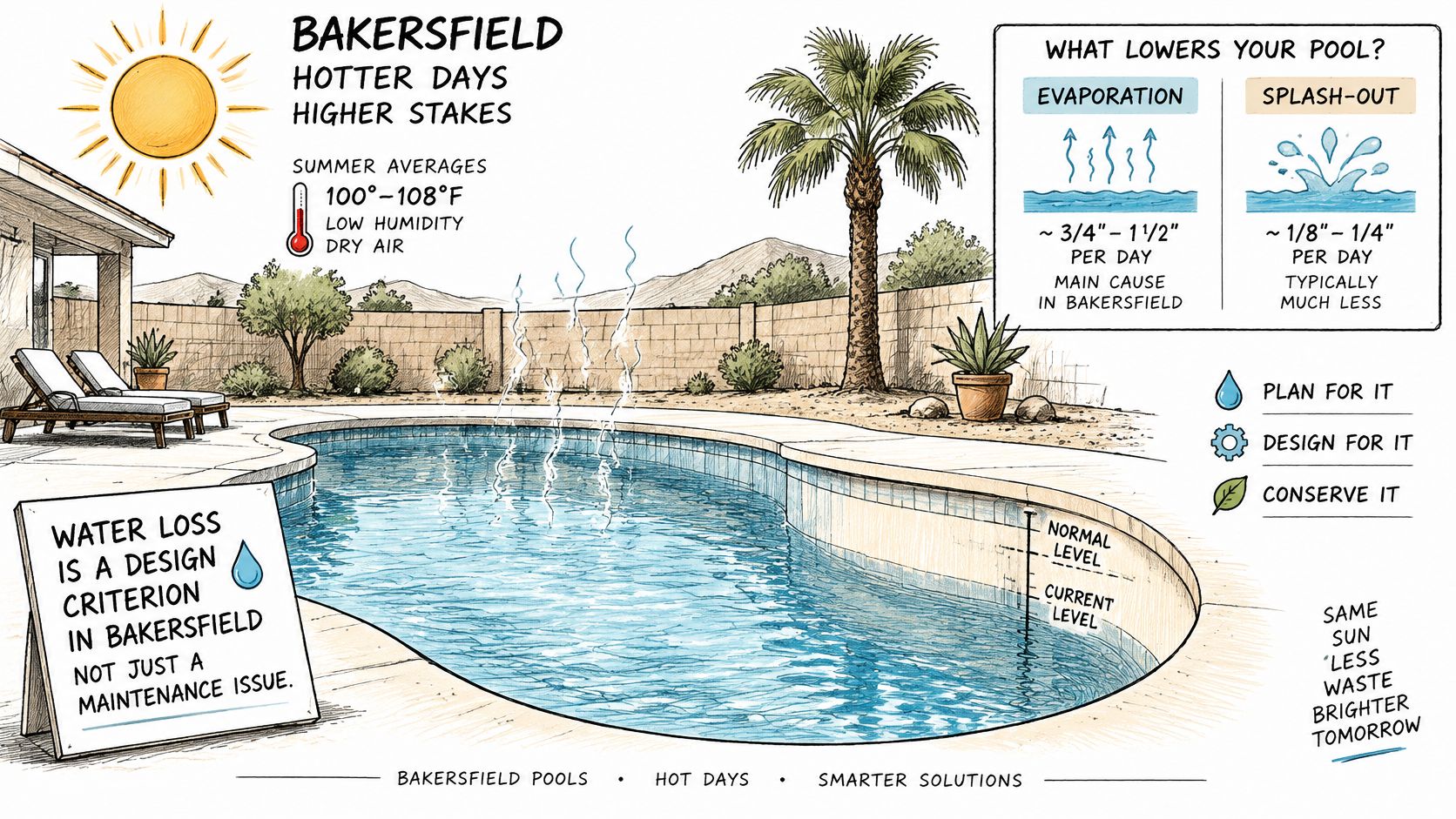
Water-conservation guidance from Water Restrictions reports that an uncovered residential pool in Bakersfield can lose approximately an inch or more of water per week during July, while a properly used cover can reduce evaporation losses by as much as 95%.
The arithmetic is worth running for your own pool. A 20-by-40-foot pool has an 800-square-foot water surface, so a one-inch weekly loss represents roughly 499 gallons before splash-out, leaks or backwashing are counted. A 95% reduction under that evaporation assumption would avoid about 474 gallons a week. Across a Bakersfield summer, that's a recurring bill and a recurring chore.
What that means for a specification:
- A fitted cover sized to the pool. Strapped or reel-mounted, and convenient enough that you'll use it every evening.
- Less exposed surface where the lot allows. A tighter shape with less free-form sprawl loses less water to the air.
- Water features on separate circulation. A spill bowl running all day adds surface area and pump hours at the same time.
- Auto-fill commissioned after leak testing. Filling devices hide leaks by topping the pool up before anyone notices the drop.
Renovation deserves the same lens. New coping and tile change how the pool looks and do nothing about evaporation, while adding a cover and repairing a leak changes the operating cost permanently. Ask your contractor to model the savings against your yard's wind exposure, the water temperature you plan to hold, and how consistently a cover would get used in your household. Those three variables decide how quickly the cover pays back its cost.
Maintenance and Renovation Across the Pool's Life
A pool needs upkeep for its whole life, not only at construction, and Bakersfield has a hard lesson on file about what happens when that upkeep stops. During the 2007 housing downturn, researchers linked abandoned properties and deteriorating pools, spas and ornamental ponds to mosquito breeding. A West Nile virus outbreak centered on the Bakersfield area that year produced 140 laboratory-confirmed human cases, an incidence of 17.5 cases per 100,000 people, and examination of 31 neglected pools from February through August 2008 yielded 8,978 adult mosquitoes, the peer-reviewed study of the outbreak reported.
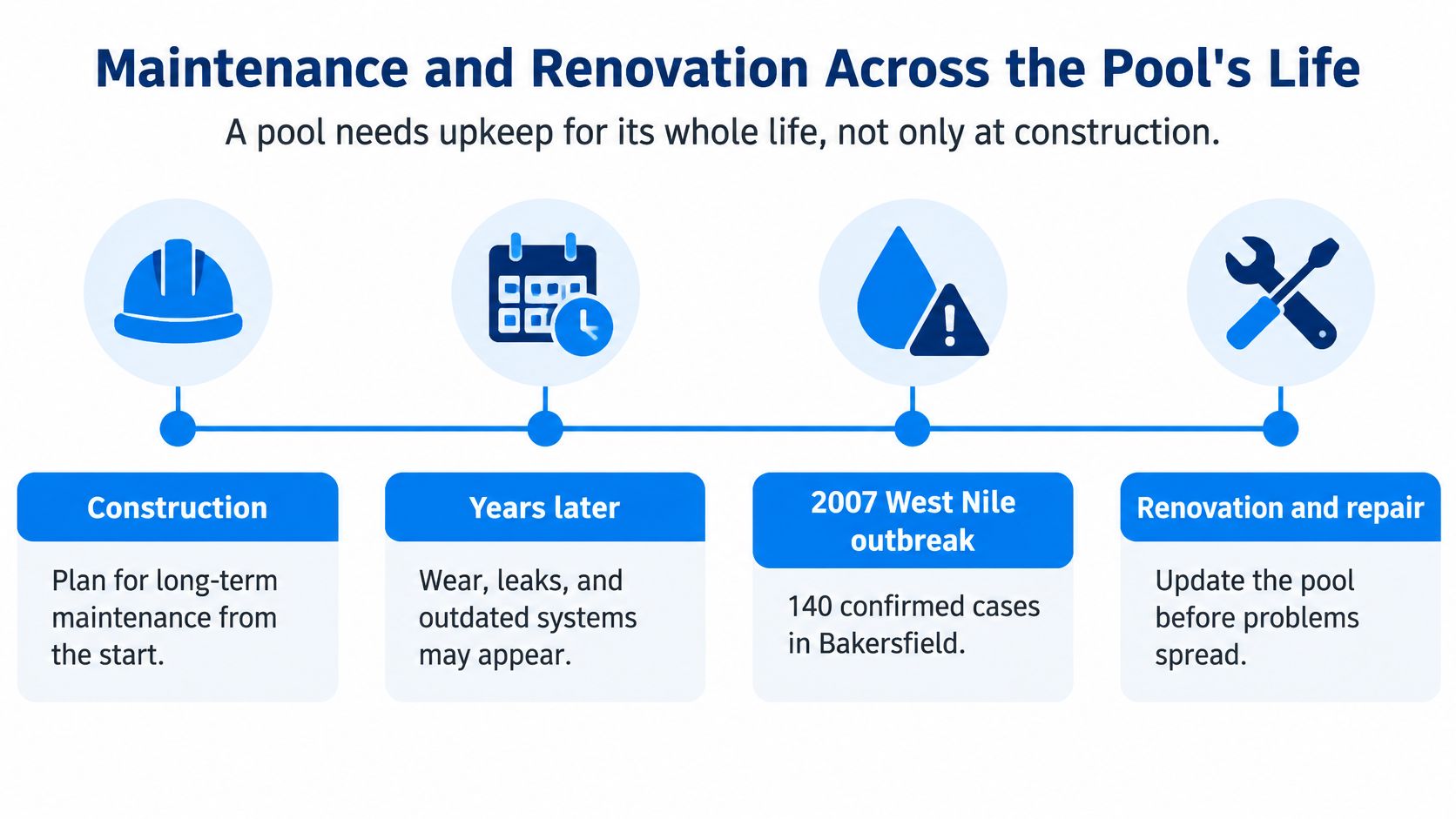
Stagnant water is a health issue before it's a cosmetic one. Here's how the ownership timeline usually runs.
First season. Confirm circulation and sanitation are working as designed, and check that the equipment installed matches the approved schedule. Learn the filter's service interval and the pump's settings now, while the commissioning visit is still fresh.
Middle years. Filter service, pump inspection, cover care and periodic testing of any fill control. Most premature equipment failures trace back to a skipped filter cycle or a pump run dry.
Later years. Resurfacing, tile and coping work, then lighting and water feature upgrades. This is when you decide whether the pool gets renovated or maintained. Before committing to finishes, look at pool renovation before and after projects to see how much of the visual change comes from tile, coping and lighting rather than the shell itself.
Set a renovation reserve when you build, not when the plaster starts to fail. A monthly figure you never touch beats a lump sum you find under pressure.
Before signing anything, ask which parts of the original design will need attention first and what the warranty covers during that window. Deferred repairs can lead to water loss and mosquito habitat much sooner than expected.
Confirm the Scope and Book Your Consultation
The scope agreed in writing is the project. Everything before that point is negotiation.
Work through four steps. First, pick the pool type you want and write down the single reason for it, whether that's shape freedom, speed or upfront cost. Second, write your budget range, your backyard constraints and how the pool will get used. Third, request at least three written bids on the same construction type and score each one against the vetting checklist and the estimate line items above. Fourth, put every unanswered question in writing before the first meeting, and don't sign until the contract scope matches the bid exactly.
Bakersfield Pool Build is one local option to test against this process. We serve Kern County and the surrounding areas and offer a free consultation and estimate. The fastest way to reach us is to call 661-378-0220; if no one answers, send a message through the website form and we'll get back to you. Our designers and builders work with you from the initial design concept through the final installation, and we're happy to put that, along with any guarantee terms, in writing before you commit.
Bakersfield Pool Build designs, builds and renovates custom pools and spas across Kern County, from the first 3D drawing to the final walkthrough, with excavation, plumbing, electrical and landscaping handled under one contract. Bring your three bids, your questions and your backyard measurements to a free consultation, and we'll put the scope, the equipment and the payment schedule in writing so nothing gets decided at the bottom of a hole. Start at Bakersfield Pool Build or call 661-378-0220.