Pool Renovation Before and After: 8 Upgrades Explained
See 8 pool renovation before and after transformations — from replastering to LED lighting — with the tactics and takeaways behind each result.
Your pool looked fine the day you bought the house. Ten years on, the plaster is chalky white, the waterline tile wears a brown crust that scrubbing won't lift, the deck has cracked into a jigsaw, and the single light in the deep end throws a yellow glow that makes the whole backyard look tired. You've stood at the kitchen window and wondered whether the only real fix is a new pool.
It isn't. Nearly every dramatic pool renovation before and after you've saved to a Pinterest board is built from the same short list of moves: resurfacing, waterline tile, coping and decking, lighting, water features, a spa, new equipment, or a change to the pool's shape. Renovation has also become a bigger slice of the trade. In Q3 2025, 42% of pool companies reported increased renovation and remodeling work while 21% reported a decline, according to the PHTA Quarterly Pulse Survey.
Each of the eight transformations below follows the same pattern: the problem the old pool had, the upgrade chosen to solve it, what changed visually, and the takeaway you can apply to your own yard in Bakersfield or anywhere in Kern County.
1. Replastering With Pebble or Aggregate Finish
Plaster fails without warning. A pool built in the 1980s or 1990s usually still has its original white marcite, which goes chalky, then rough, then starts flaking near the steps and skimmer. Chemistry stops holding, the water looks dull even when it tests clean, and the surface itself is shedding into the filter.
The decision isn't about color. It's about how deep the repair goes. The old finish gets chipped or sandblasted back to gunite, any structural crack gets opened and patched, and a new finish goes on. A pebble aggregate or quartz blend gives a harder surface than straight plaster and holds its color better under a Central Valley summer.
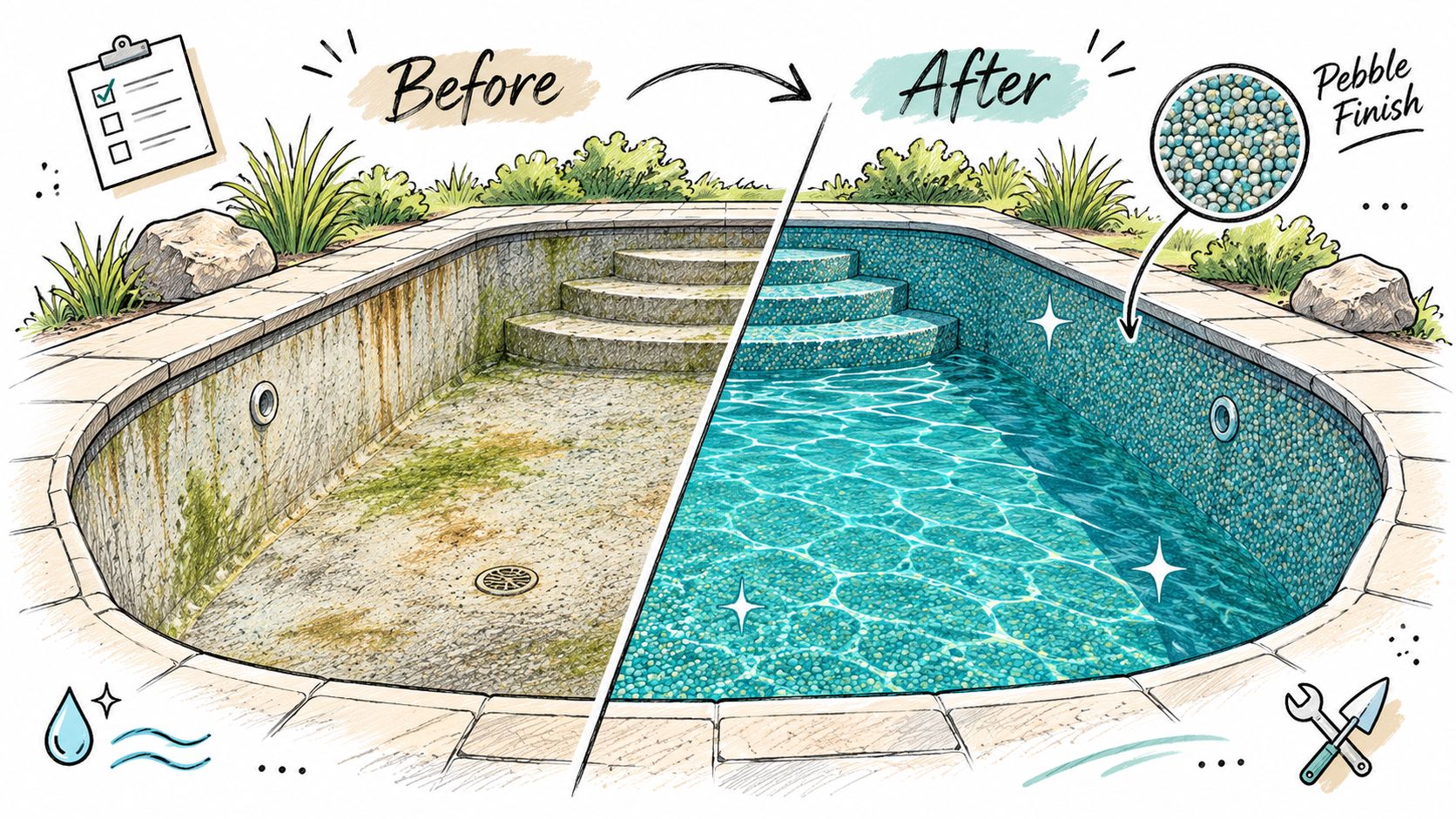
Say a pool comes in with faded white plaster and a rust stain spreading out from an old light niche. Once the shell is stripped and the niche fitting is replaced, a blue-green pebble finish reads as deeper water, hides the stain history, and gives grip underfoot that polished plaster never had.
What to settle before the pool gets drained
Confirm the shell, not just the surface. A finish laid over a moving crack is money thrown away, so pressure test the plumbing and look for structural cracking before anyone orders material.
Go lighter in a hot climate. A pale sand or light blue finish keeps water temperatures more comfortable in July than a dark charcoal or deep blue.
Book the shoulder season. Spring and fall mean less peak-season downtime and an easier schedule with the plaster crew.
Practical rule: Never pick a finish from a chip under showroom lighting. Ask for a wet sample in direct afternoon sun, because a tone that looks deep blue in shade dries pale in your yard.
Compare pool resurfacing options before you commit, since quartz, pebble and polished aggregate differ in feel, slip resistance and price. Replastering delivers the biggest visual change per dollar on this list, provided someone confirms the shell is sound first.
2. Tile and Waterline Replacement
The waterline is where a pool confesses its age. Hard water leaves a calcium crust at the water's edge, old six-inch ceramic tiles pop off in rows, and grout turns gray no matter how hard you scrub. You can shock the pool every week. The ring stays, because the tile surface itself is etched and stained.
Replacement means pulling the old tile and its thin-set bed, checking the bond coat behind it, waterproofing, and setting new material. Glass gives the most depth and shimmer. Porcelain takes chemical attack and scale better and hides hard-water film. The choice usually comes down to whether you want the waterline to disappear or to be a deliberate band of color.
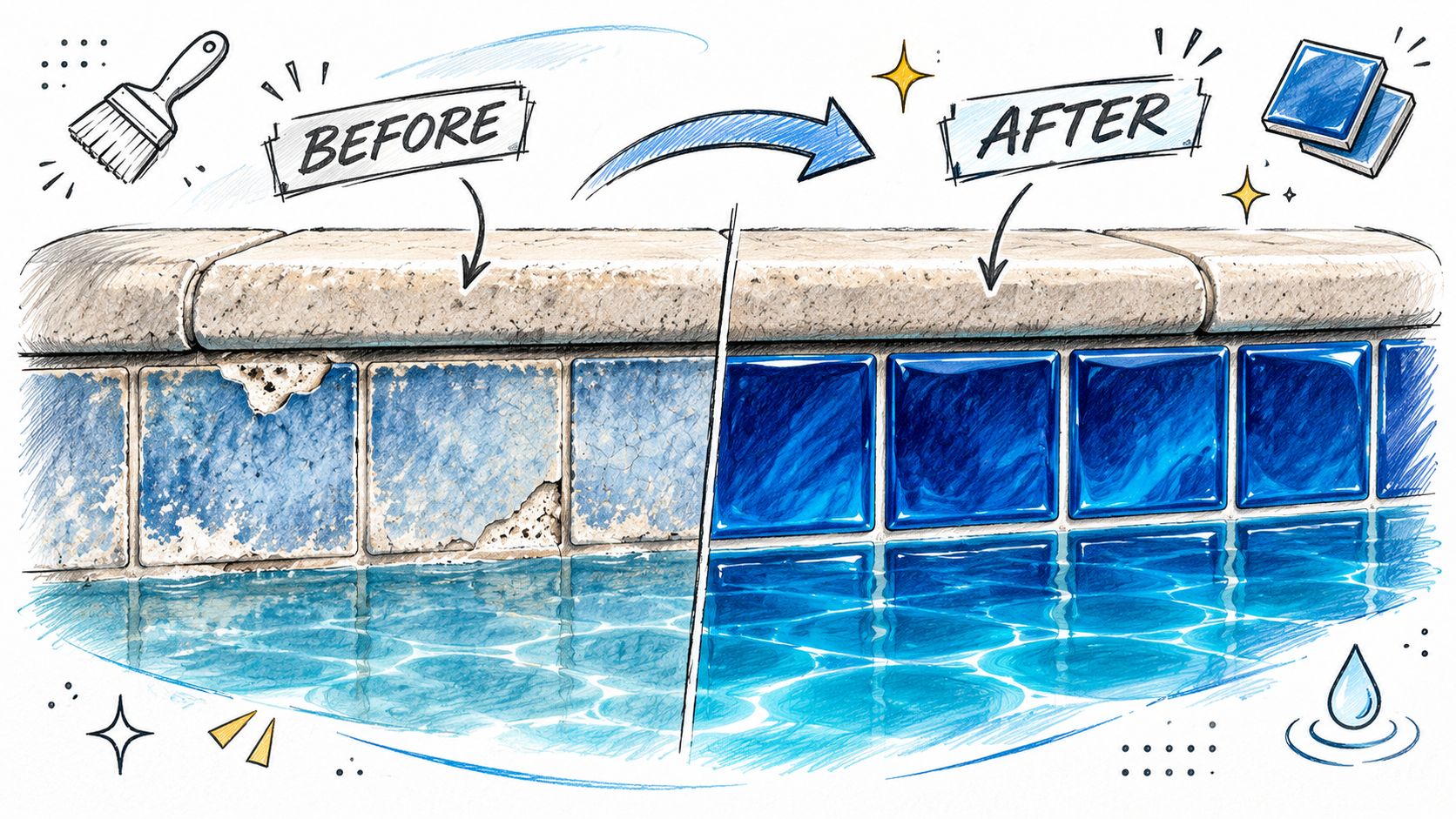
Take a pool with mineral-stained tile under a stacked-stone waterfall, white efflorescence creeping up the grout lines. Switching to a mid-tone porcelain that matches the new plaster makes the waterline read as a clean line instead of a dirty one, and the scale that does form is far less obvious between cleanings.
- Match the tile to the plaster, not the reverse. Choose the plaster from a wet sample, then pick tile against it, not before.
- Ask what's behind the tile. Waterproofing over the bond coat protects the shell, and a crew that skips it is saving an hour at your expense.
- Think about scale before you fall for dark glass. Deep blue and black glass show every white calcium line. Mid-tones forgive.
Faded, chipped ceramic swapped for glass can look stunning beside new plaster, and it looks tired again in five years if water chemistry stays hard. Tile is a finish, not a fix, so balance the water and the new tile stays new.
3. Coping and Pool Deck Replacement
A new deck costs about as much as a resurface and changes more of what you see from the kitchen window. Cracked broom-finish concrete, coping that has settled away from the shell, and pavers heaved out of level will make a well-kept pool look neglected from twenty feet away.
The choice is poured concrete against pavers. Broom and stamped concrete give one continuous surface and a clean look on day one, though stamped slabs often crack along their control joints within a few seasons. Travertine, porcelain and concrete pavers sit on a compacted base, stay cooler underfoot, and can be lifted and re-leveled if the ground moves.
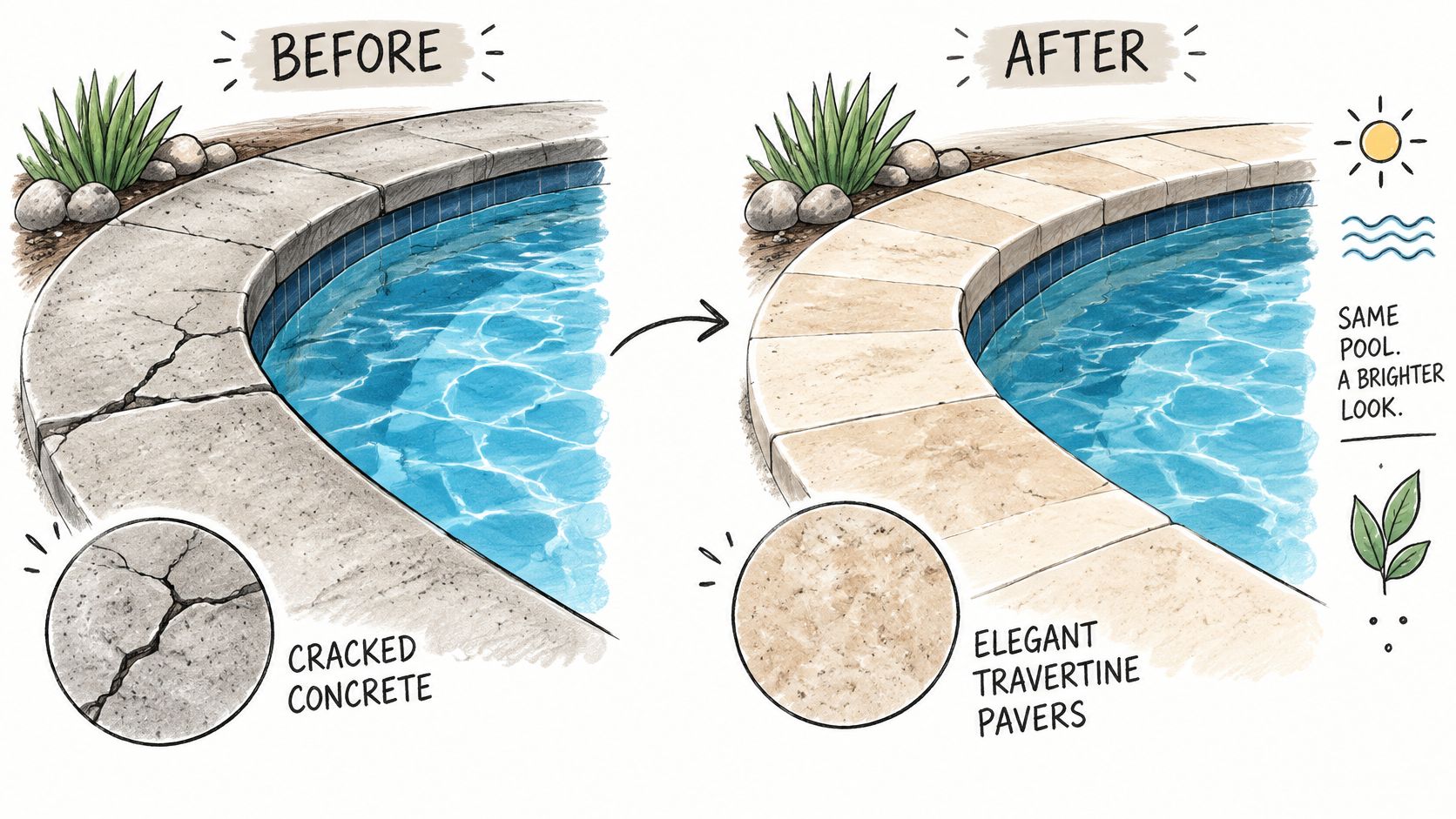
A backyard with cracked broom finish and settled coping becomes a different property with light travertine pavers, new bullnose coping and a soldier-course border at the patio edge. The light color bounces heat instead of storing it, which matters when the deck is barefoot territory in August.
Slope and drainage decide whether the deck lasts
Pitch the deck away from the shell. Water that sits against the coping finds its way behind it and starts the settlement cycle you just paid to correct.
Keep the expansion joint. The gap between deck and coping is a hinge. Fill it solid and cracks open across the slab instead.
Coordinate with landscaping. Demolition for a deck is the cheapest moment to run irrigation, gas and lighting conduit, and to reset grade.
Buy the deck for the surface you'll touch and the drainage you can't see.
4. LED Pool Lighting Upgrade
Nobody in Bakersfield swims at noon in July. The pool gets used at dusk, which makes the light fixture the most underrated item here.
Old incandescent and halogen niche lights draw real wattage, run hot, and throw a yellow cone that turns blue water green. LED fixtures are brighter per watt, run cool, and can shift color from a wall switch or a phone. In a before and after photo, the lighting change often reads bigger than the resurface.
The trade-offs are electrical. Twelve-volt pools need a transformer sized for the new load, and an older magnetic transformer won't always cooperate with a modern LED driver. The niche and its gasket have to be sound, or you'll chase water seeping behind the fixture for years. Color-changing models need a controller, and the cheap ones drop off the network.
Ask for the transformer spec first: If the pool runs 12-volt lighting, have the electrician test the existing transformer and confirm it handles the new fixture load before anyone orders parts.
A pool with one dim light in the deep end, upgraded to three fixtures, one per wall, gets even coverage with no hot spot on the far wall. That's the part worth doing before color-changing anything. Fix coverage first, add the fun second.
- Warm white for evenings. 2700 to 3000K reads relaxing. Anything above 4000K looks like a parking garage.
- Color for entertaining. A red, green or blue cycle is worth a controller, not a selling point on its own.
- Licensed electrician, always. Pool lighting sits in water, and bonding and grounding aren't a homeowner project.
Light is the cheapest way to make a tired pool feel new after dark.
5. Adding a Spa or Jacuzzi to an Existing Pool
A spa is the one upgrade here that changes how you use the pool rather than how it looks. It also adds the largest ongoing energy load, because you're heating water and holding it hot through the cool months.
Two configurations dominate. A raised spa with a spillover into the pool gives you a bench, a visual wall and a water feature in one structure, and it plumbs more easily because the shell sits above grade. A flush spa shares the pool's coping line and looks like it was always there, which is worth the extra excavation on a small property where a tall wall would crowd the space.
Regulation comes with it. California's requirements for single-family pools and spas apply when heating systems or circulation pumps are installed, which a spa addition always involves, as the California Energy Commission sets out in its energy code support materials. Get the permit scope in writing and have the electrical load confirmed before the shell gets dug.
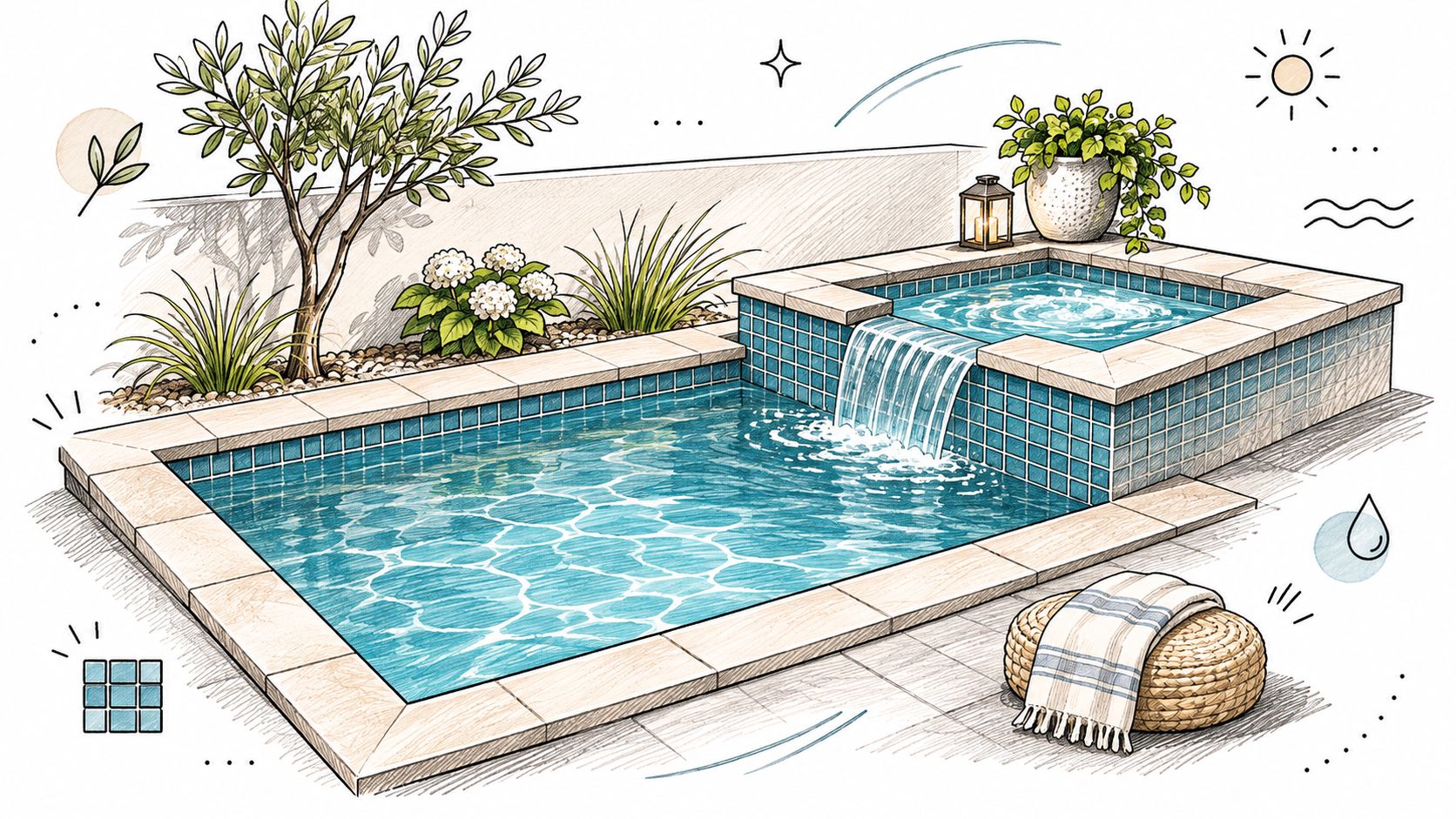
A rectangular spa set at one end of an existing pool, with matching tile and coping and a spillover that doubles as the water feature, adds a warm-water retreat without changing the pool's footprint.
- Cover it. An insulated cover keeps heat in and debris out, and it's the cheapest efficiency upgrade a spa gets.
- Size the heater to the volume. An oversized heater short-cycles; an undersized one never catches up on a cold evening.
- Plan equipment access. A spa adds a pump, blower and heater to the pad. Leave room to service them without moving the filter.
6. Adding Water Features Such as Waterfalls and Fountains
A flat pool surface is a mirror. Moving water changes the entire backyard: sheer descents, scuppers, deck jets, bubblers and stacked-stone waterfalls all add sound and motion a still pool can't match.
The trade-off doesn't come up at the showroom. Every splash and every aerated jet speeds evaporation, and in a hot, dry climate that's water you pay for at the meter and again to heat. The U.S. EPA estimates an uncovered 500-square-foot pool can lose between 12,000 and 31,000 gallons of water a year to evaporation, and heated pools can lose more, according to the EPA pool water loss estimates. Run features on a schedule rather than all day and the extra loss stays reasonable.
A lit sheer descent looks like when it's running:
Details decide whether a feature looks built in or bolted on. A sheer descent needs a level wall and its own valve or pump. Deck jets have to be set before the deck is poured, which means deciding early. A waterfall needs a footing and a liner behind the stone, not just rock stacked on the coping.
- Size the feature to the pump. Adding a waterfall to a system already running at capacity starves the filtration loop.
- Choose stone or stacked tile that handles hard water. Soft sandstone erodes in Bakersfield water; dense stone and porcelain hold up.
- Watch the chemistry. Aeration raises pH, which pushes scale onto tile and into the heater. Check alkalinity more often once water is moving.
For shapes, placements and material combinations, browse pool water feature ideas.
7. Equipment and Automation Upgrade
This is the least photogenic upgrade on the list and the one that pays back every month. A pump runs more hours than anything else on the property, and an older single-speed unit pulls full flow whether the pool needs it or not.
The energy gap is wide. The EPA's ENERGY STAR program reports that certified pumps can use up to 60% less electricity than older single-speed models, with annual savings up to $210 for a typical in-ground pool, per the ENERGY STAR pool pump toolkit.
Schedule changes matter as much as the motor. In a Northern California case study of a 20,000-gallon pool, the original 1.5-horsepower filter pump drew about 2,092 watts for six hours a day and a 0.75-horsepower cleaner booster drew 1,372 watts for 2.5 hours, roughly 15.9 kWh daily. After a variable-speed retrofit and a low-speed cleaning schedule, consumption fell to about 3.6 kWh a day, roughly 77% lower, according to the RESNET pool energy audit study.
Measure before you replace anything
Record pump wattage, daily runtime, cleaner type and filter pressure first. Without a baseline you can't tell whether new equipment helped, and an oversized replacement erases most of the savings.
Set the schedule to the turnover, not to habit: Most pools run far longer at full speed than the water requires. Cutting runtime and lowering RPM together is where the savings live.
- Right-size the pump to the plumbing. A big pump on narrow pipe wastes energy fighting friction.
- Automate the schedule, not just the lights. App control earns its keep when it runs the pump, heater and cleaner on one plan.
- Keep manuals and warranty records together. Service goes faster when the model numbers are at hand.
The change is invisible in photos and obvious on the utility bill.
8. Converting a Pool to a Lap Pool Layout
Most backyard pools are shaped for standing in, not swimming in. A freeform pool gives you a couple of strokes before you hit a wall, and no amount of tile work fixes that.
The conversion takes one of two routes. A reshape extends and squares the shell, which means excavation, rebar, gunite and a new finish blended into the old. A swim jet keeps the footprint and adds a dedicated pump and return fitting that creates a current you swim against. The jet is faster and cheaper, and it's useless if the pool is too shallow or the seat placement is wrong.
Pump speed settings matter more than motor size here. A government-supported Australian trial of eight homes that replaced single-speed pumps with three-speed models estimated average pre-retrofit consumption at 2,006 kWh a year and average savings of 872 kWh, a 43.5% reduction, because routine circulation doesn't need maximum flow, per the Sustainability Victoria pump retrofit trial. In a lap pool, that translates to running the jet while you swim and circulating slowly the rest of the day.
A standard rectangle reshaped into a long, narrow lane, with lane markings set under the water and a jet at the deep end, turns a pool the family used twice a week into one they use daily.
- Confirm the length you need. A short pool with a good jet beats a long one you can't afford to build.
- Set jet depth for your stroke. Too high and it pushes your hips down; too low and you fight to stay on it.
- Check permits before dimensions change. Altering the shell is a structural change, not a finish swap.
If you're extending the shell anyway, read about infinity pool construction before you lock the footprint, since a raised edge or catch basin changes both the structure and the permit scope.
8 Pool Renovation Upgrades at a Glance
| Renovation Type | Main Visual Change | Scope of Work | Best For | Key Trade-off |
|---|---|---|---|---|
| Replastering with Pebble or Aggregate Finish | Worn interior becomes a refreshed, durable finish | Remove old plaster and apply a new pebble or quartz surface | Pools with rough, stained, or faded surfaces | Requires draining; underlying structural cracks need repair |
| Tile and Waterline Replacement | Waterline looks cleaner and more finished | Remove and replace pool-edge tile, with waterproofing as needed | Pools with chipped, discolored, or mineral-stained tile | Poor grout sealing can allow water intrusion |
| Coping and Pool Deck Replacement | Pool edge and surrounding area gain a new look | Replace coping and deck with materials such as pavers, stone, or textured concrete | Cracked, uneven, or dated decks needing a safer surface | Demolition is disruptive; premium materials cost more |
| LED Pool Lighting Upgrade | Pool gains brighter, more even, or color-changing light | Replace older fixtures and assess wiring or transformers | Pools needing better nighttime visibility and ambiance | May require electrical upgrades and professional installation |
| Adding a Spa or Jacuzzi to an Existing Pool | Pool area gains a raised or sunken warm-water retreat | Build a spa and connect its plumbing, electrical, and equipment systems | Homeowners seeking relaxation or hydrotherapy | Adds installation, energy, and maintenance demands |
| Adding Water Features Such as Waterfalls and Fountains | Plain water surface gains movement and visual interest | Install features such as waterfalls, bubblers, scuppers, or jets | Pool areas needing a focal point and soothing water sounds | Can increase energy use, evaporation, and structural work |
| Equipment and Automation Upgrade | Little visible change; pool operation becomes more modern | Upgrade pumps, filters, heaters, controls, or automation | Owners seeking easier management and improved efficiency | Upfront cost and compatibility or setup issues |
| Converting a Pool to a Lap Pool Layout | Pool becomes longer or narrower for lap swimming | Reshape or extend the pool; optionally add swim jets or lane features | Households focused on fitness and regular swimming | Structural changes can be costly and yard space may limit the design |
Turning Your Own Before Into an After
The difference between a renovation that photographs well and one that holds up is the order of the work. Disappointing projects tend to share the same pattern: a beautiful finish sitting on top of a problem nobody diagnosed first.
Start with the diagnosis. If the pool loses water, a resurface is really a leak repair. If a light flickers, the wiring gets checked before the deck is replaced. If the water won't hold chemistry, the filter and pump get evaluated before anyone picks a plaster color.
- Test for leaks before you drain. A bucket test on the steps tells you whether you're losing water to evaporation or to a crack in the shell.
- Choose plaster and tile in the same sitting. They're read together at the waterline, and picking them weeks apart is how colors end up fighting.
- Verify structure and wiring before cosmetic work. Cracks, bond issues and old transformers are cheaper to fix with the pool empty.
- Sequence the trades. Plumbing and electrical first, then shell work, then tile and coping, then deck, then features and lighting.
Budget for what you can't see. A failed skimmer, cracking under a deck, or a pump that's been running flat out for a decade all surface once the pool is drained, and fixing them then is cheaper than fixing them a season later.
A local partner can shorten the process. Bakersfield Pool Build has more than 30 years of experience in pool installation and design, and its renovation services update tile and coping while adding water features and lighting to existing pools. Its designers and builders stay with the project from the initial concept through final installation, so each phase hands off cleanly to the next.
Our free consultations and estimates account for your budget, backyard space and lifestyle, and 3D renderings let you see the finished pool before demolition starts. Financing is available at 100% on approved credit, and a satisfaction guarantee means we'll do everything we can to make it right. We serve Bakersfield, Kern County and the surrounding California communities. Call 661-378-0220 or visit Bakersfield Pool Build to request a free estimate and find out what your before photo could become.