10 Pool Water Features Ideas for Every Backyard
Explore 10 pool water features ideas, from infinity edges and sheer descents to fire-and-water combos, with practical design and implementation tips.

Which water feature fits your backyard? Search pool water features ideas and you'll get a wall of photographs: sheet waterfalls lit from below, fire bowls on raised beams, a swimmer suspended in a glassy jet. None of those pictures shows the equipment pad, the grade of the lot, or the trench that carries a gas line. Those are the things that decide whether a feature looks right for the next twenty years or fights your property every season.
The right choice comes down to four things: how much yard you have, how the ground falls, what plumbing already exists, and how your household uses the pool. A family with three kids on a flat quarter-acre needs a different answer than a couple on a sloped lot with a valley view, even when both say they want moving water.
What follows are ten proven pool water features ideas, each judged on backyard fit and retrofit feasibility rather than how good it looks in a portfolio. For every one you'll get what it takes to build, how it behaves day to day, the maintenance nobody mentions in the brochure, and the kind of property where it belongs. Match the feature to your site and most of the hard decisions make themselves. Force a design your yard can't support and you pay twice, once to build it and again to fix it.
1. Infinity (Vanishing Edge) Pool
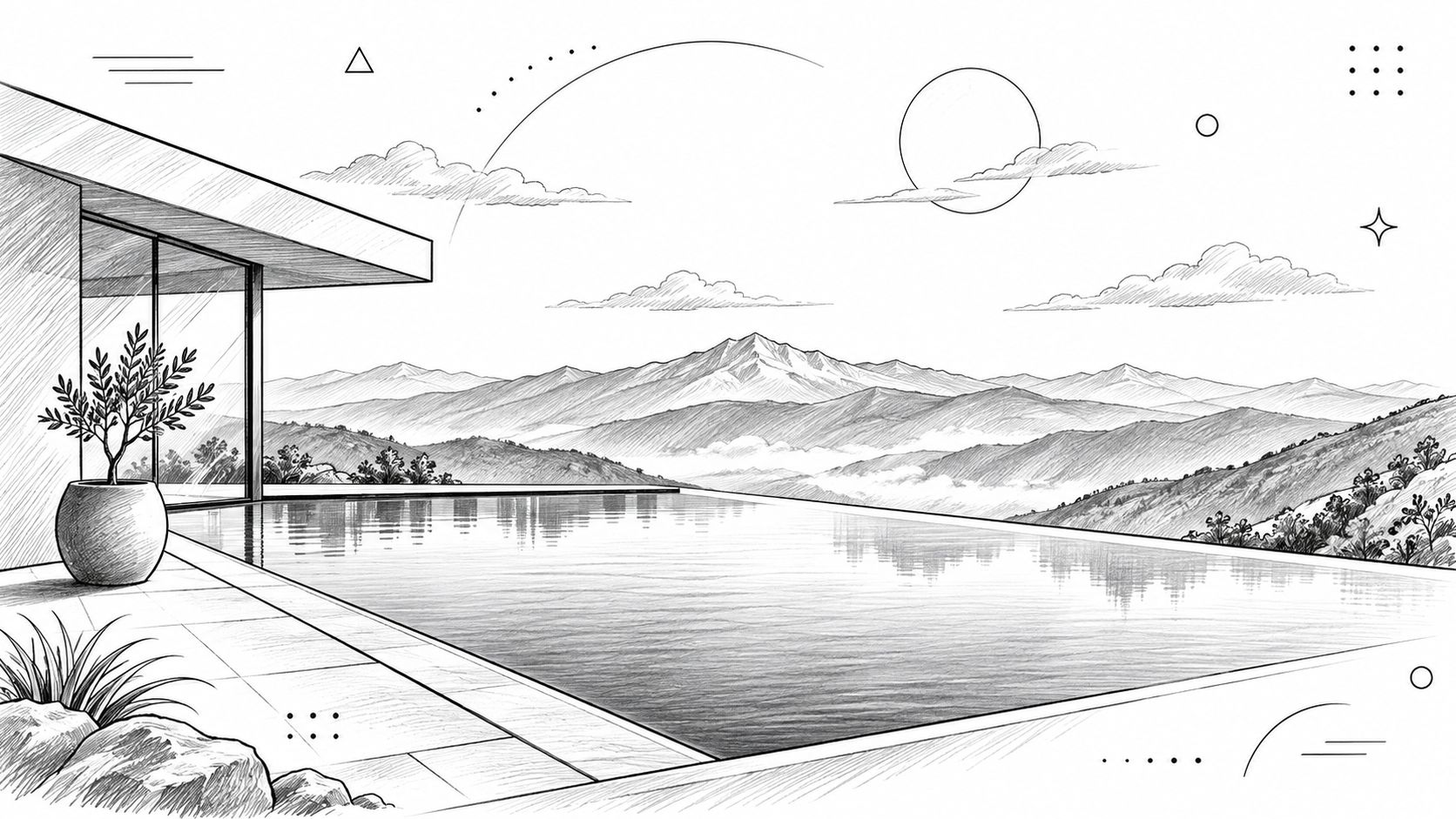
An infinity pool sets one or more edges just below the deck so the water reads as a continuous sheet pouring into the view. A concealed catch basin beneath the edge gathers the overflow and returns it to the filter. The detail is older than most homeowners assume: architect John Lautner built a vanishing-edge pool at the Silver Top residence in Los Angeles in 1957, roughly three decades before infinity pools became fashionable, as the Los Angeles Times archive on Southern California pool history records. This is a settled design category, not a novelty.
The site has to cooperate
This is the one feature on the list that can't rescue a flat, closed-in lot. The edge needs fall and a distant view to work with; on level ground it frames a fence or a neighbor's roofline and the illusion dies. Level tolerance is unforgiving too. The weir must sit within a few millimetres along its full length, or water sheets unevenly and one end of the edge runs dry.
- Size the surge basin during design: the trough has to absorb the water bathers displace plus wave action, or the pump pulls air every busy afternoon.
- Budget for water loss: a wide, wind-exposed edge evaporates more than anything else here, so pair it with a cover and an automatic fill.
- Frame the view from where you sit: the edge should line up from the kitchen window and the patio chairs, not from the far end of the deck.
- Check your grade first: if the fall is under about a metre, the money usually buys more impact somewhere else.
A property backing onto a greenbelt or sitting above the street below is the natural candidate. On a flat lot, I'd move to the next idea and put the difference into a covered patio. Our Bakersfield pool designers can walk the grade with you before anything gets excavated.
2. Sheer Descent Waterfall
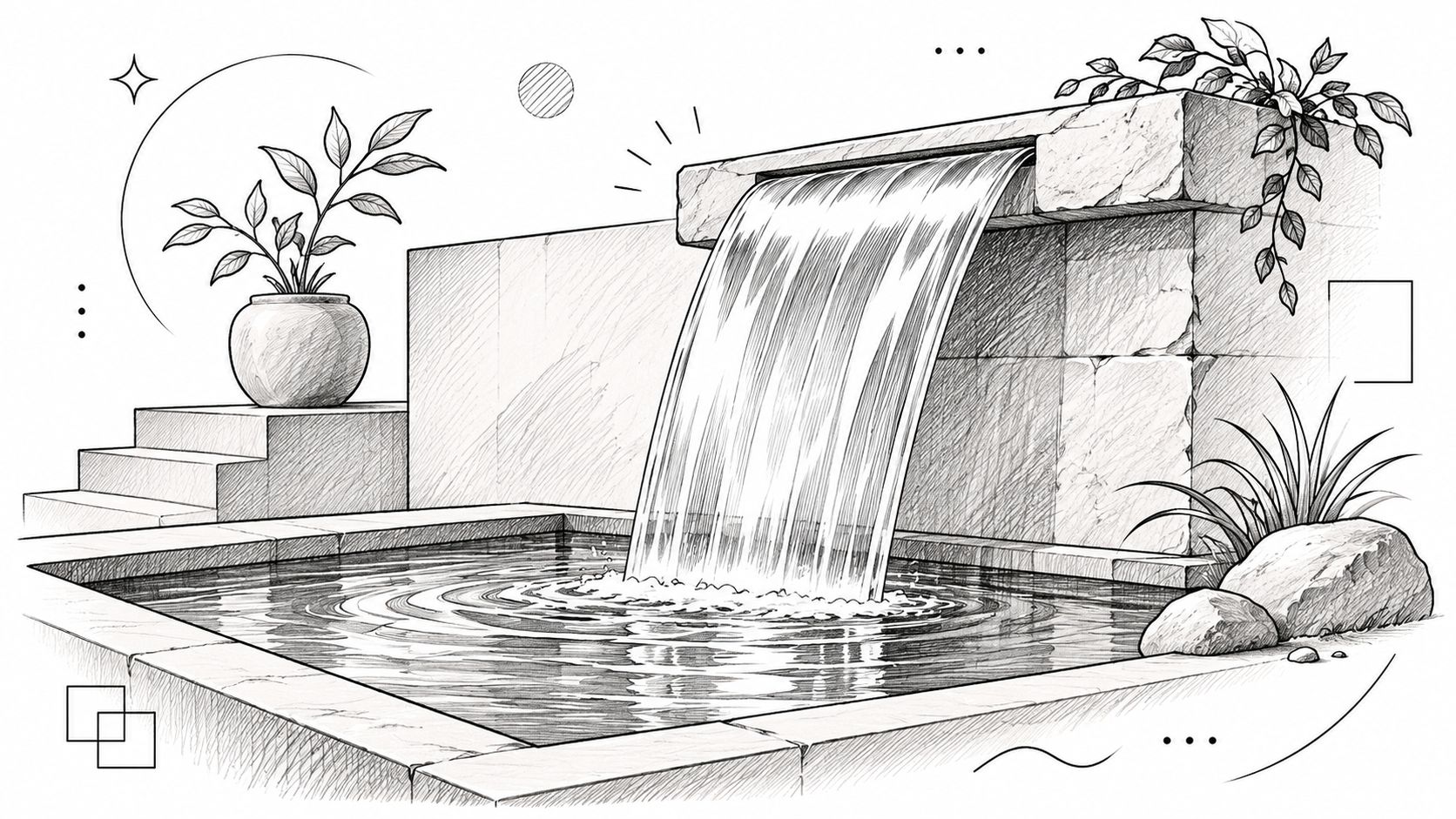
A sheer descent is a wide, thin sheet of water that leaves a raised lip and falls as a clean glassy panel instead of a splashy cascade. It's the most retrofit-friendly option on this list. If the pool has a spare return line and room on the pad, a spillway can be built into a new raised beam or an existing wall without touching the shell, which is why so many older pools pick one up during a renovation.
The running cost is water and pump hours
Any feature that lifts water into the air and drops it back adds evaporation. A Metropolitan Water District estimate reported by Green Building Advisor puts evaporation from a typical uncovered pool at about 19,659 gallons a year, and the same source notes that pool pumps averaged 4,200 kilowatt-hours annually across monitoring of 204 Florida homes. A dedicated pump, a timer, and a solid cover do more for that bill than any nozzle upgrade.
Say your pool was built with a plain raised beam at the deep end. A three-foot spillway across that beam, fed by its own small pump on a schedule, changes the whole back wall for a fraction of what a new build costs.
- Match the finish to the coping: the same stone or tile as the existing edge makes a retrofit read as original work.
- Move the pad away from bedrooms: a waterfall pump cycling at six in the morning is a noise complaint waiting to happen.
- Ask your water district about high-flow features: Kern County guidance is worth checking before you commit to a big spillway.
- Run the electric during excavation: conduit is cheap in an open trench and expensive through finished concrete.
3. Deck Jets and Laminar Fountains
Deck jets are nozzles set flush in the deck that throw arcs of water back into the pool. Laminar jets do the same job with more control, producing a smooth glassy rod of water that barely breaks apart. Both are inexpensive next to a waterfall, both zone easily, and both point water straight up, which is the configuration the EPA technical sheet on pools and outdoor water features cautions against. That guidance states evaporation increases with flow rate and recommends cascading water that falls downward rather than shooting upward, along with smaller pumps and reduced pumping rates. Run jets as a show, not as a constant.
Here's the effect a synchronized jet and light system produces after dark:
Fitting them to a real yard
Jets suit a flat lot with a small deck and a household that swims at night, and they suit a renovation because the plumbing can often be pulled through existing decking with one saw cut and a patch.
- Place nozzles against the lighting plan: a jet lit from the side glows; one lit from behind just looks wet.
- Give them a dedicated valve: the jets should be adjustable without starving the filtration returns.
- Aim overspray at water, not concrete: wet pavers around a pool are a slip hazard, and they stain over time.
- Check the nozzle screens twice a season: grit and scale turn a laminar rod into a sputtering mess.
Teenagers who swim after dinner get more use from a row of six jets than from a waterfall they look at through a window. A quiet couple who want background sound should skip this one. Jets are loud, and the noise carries across a small yard.
4. Bubbler and Water Bowl Feature
A bubbler pushes a gentle upwelling of water over a stone bowl, urn, or basin set on a tanning ledge or at the pool edge, and the water spills back into the pool. It's the cheapest real feature here and the friendliest to small yards, because it occupies roughly the footprint of a planter. A 12-by-24-foot backyard that would feel crowded by a waterfall can carry two bubblers and still leave room to walk.
Where it works and where it doesn't
The best placement is a shallow sun shelf, where the bowl becomes somewhere to sit and the spill is audible from the house. The failure mode is a bowl set too close to a walkway, so the spill runs across the deck and leaves a permanent wet stripe.
Material matters more than people expect. A porous bowl in hard water scales and stains within a season; a sealed, glazed, or cast-stone vessel holds up far better and wipes clean.
- Choose a bowl you can lift: you'll be scrubbing it, and a basin too heavy to remove stays green.
- Set the spill clear of steps and paths: water should land back in the pool, not on the coping.
- Put the feature on a timer or low-flow setting: it's decorative, so it doesn't need to run while you're at work.
- Inspect the face of the bowl, not just the water: mineral deposits form where water runs down, not where it starts.
A bowl you can't lift off its base is a bowl you'll stop cleaning by August.
A small courtyard pool with two urns on the entry side and lighting behind them delivers the sound and the look on a modest budget. If the yard is generous and the budget is tight, bubblers are where I'd start.
5. Rain Curtain or Rain Wall
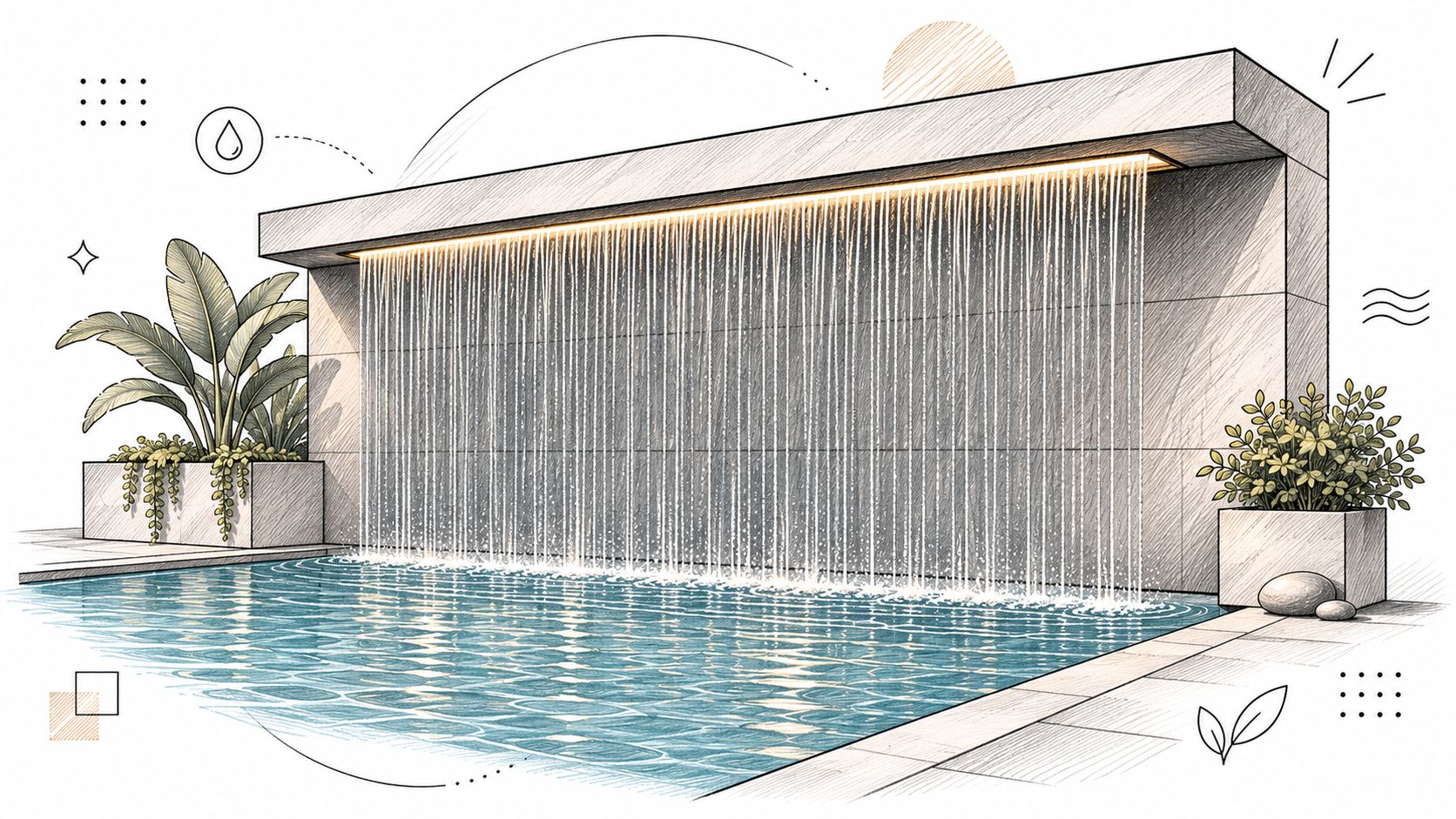
A rain curtain drops water from a horizontal trough through a row of small orifices, creating a sheet of many thin streams that reads as falling rain. Backlit from below, it's the most architectural effect on this list. It's also the heaviest water-to-air contact of any feature here. The California Water Efficiency Partnership guidance on pools, spas and fountains identifies waterfalls, sprays, and other features that increase water-to-air contact as evaporation drivers, and recommends limited operation, wind protection, efficient filtration, leak monitoring, and covers. The same conservation guidance reports that an uncovered 16-by-36-foot pool can lose as much as 180 gallons a week, about 720 gallons a month, to evaporation, and that shutting off waterfalls and fountains reduces those losses.
Design rules for a curtain
Wind decides whether a rain wall reads as elegant or soaks your patio furniture. Put the curtain on the leeward side of the pool, or use the house or a garden wall as a windbreak.
- Give it its own pump and filter: a curtain needs clean water at steady pressure and shouldn't steal flow from the pool's circulation.
- Use stainless or a treated frame for the trough: a rusted header streaks the wall below it within a year.
- Run it for company, not for hours: a timer plus a manual switch turns a dramatic effect into a controlled one.
- Light it from the trough down: uplighting turns falling water into a lit screen.
A homeowner who entertains a dozen times a year runs a rain wall hard on those nights and never misses it on a Tuesday. Anyone who wants constant ambient sound should choose a sheer descent instead, which throws far less spray into the air.
6. Spa-to-Pool Spillover
A raised spa that spills over a shared wall into the main pool gives you two things in one structure: a heated seat and a moving water feature with built-in sound. It's the most space-efficient option on this list. On a lot where a separate spa would eat the whole patio, stacking the spa above the pool edge buys back deck you would otherwise lose.
The hidden cost is heat
Water that spills continuously loses heat and drives the equipment harder. Every pass over the weir exposes warm water to moving air, so the heater runs longer and the pump works more hours than a still spa would demand. Plan for that operating cost before you commit, because a spillover billed as a two-for-one feature becomes the most expensive feature you own if it runs around the clock.
- Coordinate water levels in design: a spillover weir sets the height of both bodies of water, and a miscalculation shows up as a spa that drains when the pump stops.
- Use a non-porous edge material: spillway stone takes constant wetting and mineral load, and soft stone stains dark.
- Heat the spa separately: an independent heater lets you keep the pool cooler and the spa hot.
- Cover both: a spa left open in winter is the largest heat loss on the property.
A couple who use the spa four nights a week get far more from this than from any waterfall. A household that ignores the spa after the first month should put the budget into a sheer descent, because a spillover costs energy every hour it runs.
7. Color-Changing LED and Fiber Optic Lighting
Lighting isn't a water feature on its own, but it's the cheapest way to make every other feature on this list look twice as expensive. Modern LED fixtures change color, brightness, and pattern from a wall panel or a phone, and they can be synchronized so jets, spillways, and the pool shell shift together. Fiber optic runs light to points where a fixture won't fit: star fields in a spa ceiling, pin lights under coping, a glow inside a bowl.
Retrofit reality
The wiring is the constraint, not the fixture. Conduit has to reach each niche before the deck goes down, so a lighting upgrade on an existing pool is easiest when the deck or the finish is already coming out. If you're resurfacing, that's the moment to run conduit for two extra niches and a transformer sized for future additions.
- Buy 12-volt fixtures rated for pool use: and have a licensed electrician make the connections on a GFCI-protected circuit.
- Plan the transformer location: it needs ventilation, code clearance, and a spot an adult can reach without crawling behind shrubs.
- Default to warm white: saturated colors are for parties; warm white is what you'll run most nights.
- Sync the lights to the features: a white spillway against a blue shell reads as a designed scene, and clashing colors read as a mistake.
Practical rule: treat lighting as part of the plumbing plan, not an afterthought once the deck is sealed.
Reviewing pool resurfacing options is the honest starting point for a lighting retrofit, because the finish and the wiring get done in the same pass and the deck only comes apart once.
8. Pool Water Slide
A slide is recreation, not decoration, and it's the feature most likely to be used daily by the people it's built for. Fiberglass and stainless models come straight, curved, or enclosed, and they mount on a raised deck, a natural slope, or a built platform. Retrofit feasibility is poor. A slide needs structural support, a dedicated water line to keep the flume wet, a specific depth at the exit, and clear run-out in the pool. On a finished pool, that usually means no.
The measurements that matter
Depth at the slide exit comes from the manufacturer's instructions, not from preference, and inspectors check it. Platform height, handrail height, and the distance from the flume to the pool wall come from the same document. Get the spec sheet before the deck is poured.
- Build shade over the flume: fiberglass in afternoon sun gets hot enough to hurt bare legs.
- Add a wetting line with its own valve: a dry slide is a slow slide, and the valve lets you dial flow to what the maker requires.
- Use non-slip treads on the steps: wet feet on a ladder cause more injuries than the slide itself.
- Confirm fence and setback rules early: pool barrier codes apply to the platform and steps, and moving them later is expensive.
Ask before you pour: the deck height that makes a slide fun is also the dimension an inspector will measure against the manufacturer's spec.
A family with children between about five and twelve gets years of use from a slide and stops using it around the time the kids discover phones. For an adults-only household, the same budget buys a much better spa.
9. Counter-Current Swim System
A counter-current system uses a high-volume pump to push a current against a swimmer, so a compact pool can train someone for a mile. It answers the usual complaint that a backyard can't hold a lap pool: a 40-foot pool eats a yard, a small pool with a swim current doesn't. Pace settings let you hold a steady effort without turning at a wall.
What it demands from the build
The pump is the whole system, and undersizing it produces a current you can walk against. Sizing comes from the pool volume and the flow speed the manufacturer specifies, not from guesswork on the pad.
- Set the depth for swimming, not standing: too shallow and your hand hits the floor on the catch; too deep and the current dissipates before it reaches you.
- Return the flow properly: a strong jet needs a well-placed suction and return so the current stays smooth instead of churning.
- Cover the pool in summer: a small heated pool loses heat and water quickly when it's uncovered and idle.
- Keep the strainer basket clear: a partially blocked basket reduces the flow you paid for.
Retrofit is possible on some pools with a wall-mounted unit, but most systems work best designed in, when the shell, plumbing, and electrical can be laid out together.
Say a homeowner swims four mornings a week and has a 16-by-30-foot yard. A compact pool with a counter-current unit plus a spa spillover delivers training and recovery in the footprint a lap pool would need on its own.
10. Fire and Water Combination Feature
Fire and water together work because they solve a small-yard problem: two focal elements share one footprint. A fire bowl set beside a bubbler, or a fire wall with a sheer descent running through it, gives a courtyard a reason to be used after dark. The gas line decides feasibility, and it has to be trenched before the deck is poured.
Safety and siting
Clearance isn't negotiable. Fire features belong away from overhangs, umbrellas, furniture, and the pool edge, and the wind that makes a waterfall look good will push water onto a flame or flame toward a seat.
- Hire a licensed gas contractor: the line, the shutoff, and the inspection are not a homeowner project, and insurers ask about them.
- Place the burner where wind won't fight it: a crosswind turns a fire bowl into a smoke machine aimed at the seating area.
- Keep the water element low: a bubbler beside a bowl reads better than a spray, and it doesn't put water on the flame.
- Plan the seating radius first: the feature exists to make people sit down, so lay out the chairs before the gas.
A fire feature with no chairs around it is a decoration. A fire feature with chairs around it is the reason the backyard gets used in January.
A narrow side courtyard off a kitchen is the classic case. Two chairs, a small fire bowl, a low bubbler, and a screen of planting turn dead square footage into the most-used spot on the property. The money goes into the gas line and the hardscape, not the bowl.
Pool Water Feature Comparison
| Feature | Relative Cost | Installation Effort | Best For |
|---|---|---|---|
| Infinity (Vanishing Edge) Pool | Very high | Extensive engineering and construction | Sloped or view-rich properties seeking a dramatic design |
| Sheer Descent Waterfall | Moderate | Moderate; may be retrofitted with plumbing access | Adding a focal point and soothing water sound |
| Deck Jets and Laminar Fountains | Moderate | Moderate; requires plumbing and pump coordination | Resort-style movement and lighting in new or existing pools |
| Bubbler and Water Bowl Feature | Low | Simple; minimal structural work | Small yards and budget-friendly pool upgrades |
| Rain Curtain or Rain Wall | Moderate to high | Detailed plumbing and flow setup | Modern designs, privacy screens, and dramatic water effects |
| Spa-to-Pool Spillover Feature | High | Extensive design and water-level coordination | Combining a spa and pool in a cohesive layout |
| Color-Changing LED and Fiber Optic Lighting | Low to moderate | Low to moderate; electrical installation required | Enhancing existing pools and nighttime entertaining |
| Pool Water Slide | Moderate to high | Moderate; requires a stable platform and suitable pool depth | Family recreation and backyard gatherings |
| Counter-Current Swim System | High | Significant; requires a high-output pump and compatible pool | Fitness and aquatic therapy in a compact space |
| Fire and Water Combination Feature | High | Extensive; requires permitted gas installation | Upscale outdoor entertaining and evening ambiance |
From Idea to Finished Feature
The feature that photographs best and the feature that suits your yard are rarely the same one. Work the other direction: sketch the space, mark where the sun lands in the afternoon, note whether the ground falls or sits flat, and list what your household does in a pool. A family with young children on a flat lot ends up somewhere very different from a couple on a sloped property with a long view, and both can be right.
Then get engineering input before anyone quotes you a feature. Plumbing, surge capacity, the gas line, and the conduit are what make a feature work or fail, and all of them get decided in the design phase. Changing a spillway width after the beam is poured is a demolition job. Changing it on paper costs nothing.
Budget with a realistic eye as well. The visible element is usually the smaller line item. Excavation on a tight side yard, a trenched gas line, a new pump and its electrical circuit, and deck repair around a retrofit routinely cost more than the bowl or the spillway itself. Ask for those numbers separately so you can see what you're really buying.
Bakersfield Pool Build has more than 30 years of experience designing and installing pools with waterfalls, fountains, custom lighting, and integrated spas across Kern County. Consultations and estimates are free and take your budget, yard space, and lifestyle into account, and the design includes 3D renderings so you can see the feature on your own lot before construction starts. The team handles excavation, plumbing, electrical, and landscaping as one scope, offers 100% financing on approved credit, backs the work with a satisfaction guarantee, and answers the phone around the clock at 661-378-0220.
One last piece of sequencing advice. If you're renovating an existing pool, group the work. Run conduit for lighting while the finish is off, plumb the feature while the deck is open, and trench the gas line before the hardscape goes back down. Three separate projects cost far more than one organized one, and the pool only has to be torn up once.
Start with the site, not the photograph. The right feature for your yard will look like it was always there, and the wrong one will look installed.
Bakersfield Pool Build designs and installs custom pools with waterfalls, spillways, bubblers, lighting, and integrated spas, and it renovates existing pools when a new feature needs different plumbing, structure, or electrical work. The team walks your property, matches the feature to the yard and the way you swim, and shows you the finished result in a 3D rendering before excavation begins. Visit Bakersfield Pool Build or call 661-378-0220 to book a free consultation.
Prepared with the Outrank app